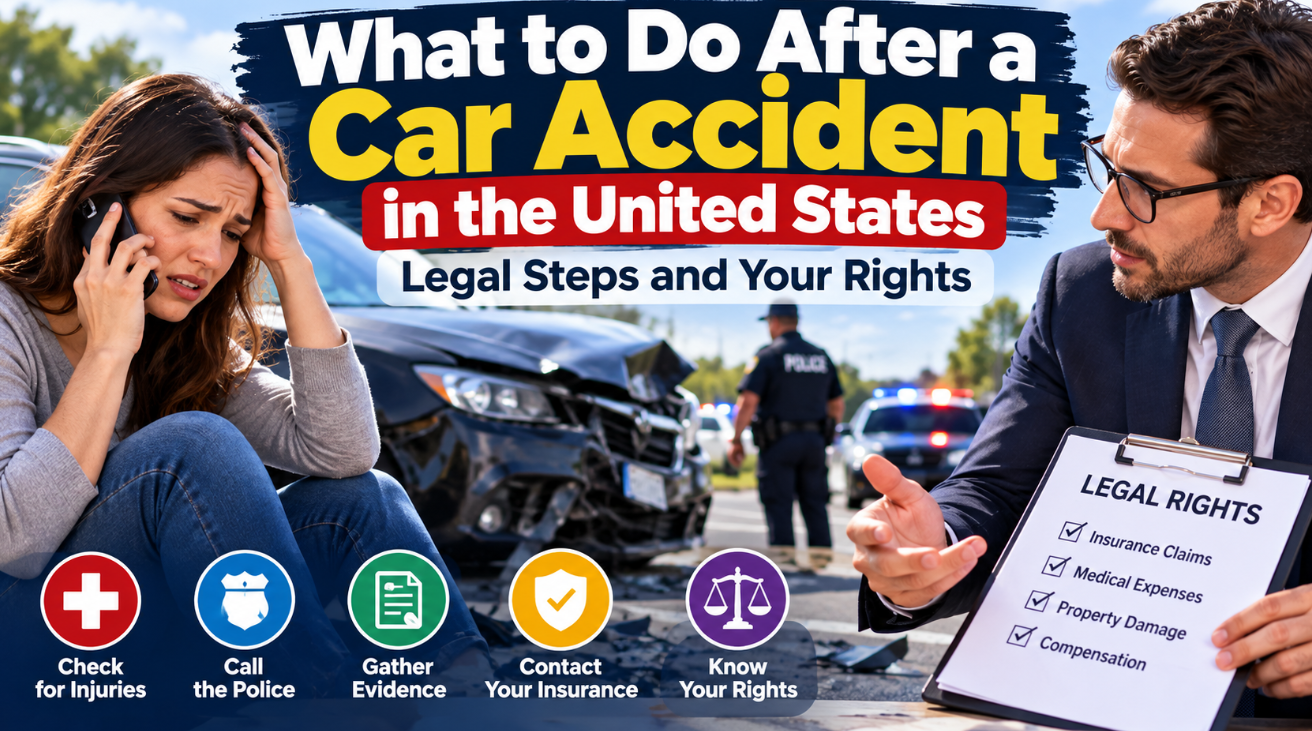
A car accident can happen in seconds, but the consequences may last for months or even years. Whether you are involved in a minor collision or a serious crash, knowing what to do after a car accident in the United States can help protect your safety, document your losses, and avoid common mistakes when dealing with insurance companies.
After an accident, you may face unexpected medical bills, vehicle repairs, lost income, and questions about who is responsible for the collision. You may also wonder whether you need a car accident lawyer and what legal rights you have.
The steps you take immediately after a crash can make a difference when you file an insurance claim or seek compensation for your injuries.
This guide explains what to do after a car accident, how to document the scene, how insurance claims work, and when speaking with a personal injury attorney may be helpful.
1. Check for Injuries and Move to Safety
Your first priority after a car accident should always be safety.
Check yourself and your passengers for injuries. If anyone appears seriously injured, call 911 and request emergency assistance. Avoid moving a person who may have a serious neck, back, or spinal injury unless there is an immediate danger, such as a fire.
If the vehicles are creating a traffic hazard and can be moved safely, move them out of the roadway when appropriate. Turn on your hazard lights and remain in a safe location while waiting for assistance.
Even if the collision appears minor, do not assume that everyone is unharmed. Some injuries may not become noticeable until hours or days later.
Seek medical attention if you experience pain, dizziness, headaches, or other symptoms following the crash. Prompt medical evaluation can help identify injuries and create a record of the treatment you receive.
2. Call the Police When Appropriate
Contact law enforcement when someone is injured, a driver leaves the scene, or the circumstances require an official response. State and local rules may also require reporting certain collisions based on the amount of damage or other factors.
When officers arrive, provide factual information about what happened. Avoid guessing about details you do not remember.
If an official accident report is prepared, ask how you can obtain a copy. The report may contain information about the drivers, vehicles, witnesses, road conditions, and the officer’s observations.
An accident report can be useful when filing an insurance claim, although it does not necessarily determine legal responsibility by itself.
If the police do not respond to a minor collision, check the reporting requirements in the state where the accident occurred.
3. Exchange Information With the Other Driver
Before leaving the scene, if it is safe to do so, exchange the necessary information with the other driver.
Try to collect:
- Full names and contact information.
- Driver’s license information.
- Vehicle registration details.
- License plate numbers.
- Insurance company names and policy information.
- The make, model, and color of the vehicles involved.
- Contact information for passengers and witnesses, when appropriate.
You can photograph the other driver’s insurance card and relevant vehicle documents if they are available.
Keep the conversation calm and focused on exchanging information. Do not argue about fault or make promises to pay for the other person’s damages.
You should cooperate with required information exchanges, but avoid speculating about the cause of the crash before all the facts are known.
4. Take Photos and Gather Evidence
Evidence collected at the accident scene may help you explain what happened and support your insurance claim.
If you can do so safely, use your phone to photograph or record:
- Damage to all vehicles involved.
- The positions of the vehicles.
- License plates.
- Traffic signs and signals.
- Road conditions and weather.
- Skid marks, debris, and visible hazards.
- Visible injuries, when appropriate.
Write down the date, time, location, and your recollection of the accident while the details are still fresh.
If witnesses saw the collision, ask for their names and contact information. Their observations may become useful if the drivers disagree about what happened.
Preserve dashcam footage, relevant messages, repair estimates, and other documents related to the crash. Keep original files when possible and make backup copies.
For additional guidance, the Texas Department of Insurance’s car accident guide explains how drivers can document a collision and prepare for the claims process.
5. Notify Your Insurance Company
After a collision, contact your insurance company as soon as reasonably possible and follow the reporting requirements in your policy.
Many policies require prompt notification, even when you believe another driver caused the accident.
When you report the collision, be prepared to provide:
- The date and location of the accident.
- The vehicles and drivers involved.
- A description of what happened.
- Information about any injuries.
- The police report number, if available.
- Photographs and other supporting documentation.
Ask for your claim number and the contact details of the insurance adjuster assigned to your case.
Review your policy to understand your coverage, deductible, rental car benefits, medical payments coverage, and collision coverage.
If the other driver appears responsible, you may also be able to pursue a claim through that driver’s insurer. The available options depend on the facts, the applicable law, and the insurance policies involved.
You can find consumer guidance through your state’s department of insurance.
6. Understand Your Rights After a Car Accident
Your legal rights depend on the state where the accident occurred, the circumstances of the collision, the insurance coverage available, and the nature of your injuries.
Depending on the applicable law and evidence, you may be able to seek compensation for certain losses caused by another party’s negligence.
Potential damages may include:
Medical Expenses
These may include emergency treatment, hospital visits, diagnostic tests, medication, rehabilitation, and other medically necessary care related to the accident.
Keep copies of your medical bills, receipts, and treatment records.
Lost Wages
If your injuries prevent you from working, you may be able to claim eligible lost income. Documentation from your employer, pay records, and medical restrictions may help establish the loss.
In some circumstances, a claim may also involve reduced future earning capacity.
Vehicle Damage
Depending on the coverage and liability rules that apply, you may seek payment for reasonable vehicle repair costs or the value of a vehicle that is considered a total loss.
Save repair estimates, photographs, towing invoices, and rental car receipts.
Pain and Suffering
Some injury claims may include compensation for physical pain, emotional distress, and the effects of an injury on daily life.
Eligibility and the amount of any recovery depend on the facts of the case and applicable state law.
Shared Responsibility for an Accident
More than one person may contribute to a collision. Some states allow injured people to recover damages even when they share some responsibility, subject to rules that may reduce or limit recovery.
Other states apply different standards. Do not assume that being partly responsible automatically eliminates a claim or guarantees compensation.
A qualified attorney can explain how the rules in your state may apply.
7. Be Careful When Speaking With Insurance Adjusters
Insurance adjusters investigate claims and evaluate the information available to the insurance company. Their questions may concern how the accident happened, the damage to your vehicle, and any injuries you report.
You should provide accurate information and cooperate with legitimate claim requirements. However, it is important to understand what you are being asked to sign or agree to.
Consider these precautions:
- Do not exaggerate or speculate about your injuries.
- Keep copies of documents you submit.
- Ask for clarification when a request is unclear.
- Review written settlement offers carefully.
- Understand any release before signing it.
- Consider obtaining legal advice if you have significant injuries or disputed liability.
You should not automatically accept the first settlement offer without understanding the extent of your injuries, the losses you have incurred, and any continuing treatment needs.
A settlement may require you to give up the right to pursue additional compensation for the claims it covers. Before accepting an offer, make sure you understand its consequences.
8. What If the Other Driver Has No Insurance?
Being hit by an uninsured driver can create additional financial difficulties, particularly if you need medical treatment or expensive vehicle repairs.
Depending on your policy and state law, possible options may include:
- Uninsured motorist coverage.
- Personal injury protection, where applicable.
- Medical payments coverage.
- Collision coverage for vehicle damage.
- A claim against the responsible driver, where legally and practically appropriate.
These options do not apply in every situation, and coverage limits, deductibles, exclusions, and reporting requirements may affect your claim.
Review your policy and speak with your insurance company about which benefits may be available.
If the other driver leaves the scene, report the incident to law enforcement as required and provide any information you have about the vehicle and driver.
9. When Should You Hire a Car Accident Lawyer?
Not every collision requires an attorney. A minor accident involving limited property damage and no injuries may be resolved through an insurance claim.
However, legal representation may be worth considering when:
- You suffered serious or lasting injuries.
- The insurance company disputes who caused the accident.
- The insurer denies your claim or offers an amount that does not adequately address your documented losses.
- Several drivers or parties may be responsible.
- You have substantial medical expenses or lost income.
- The other driver is uninsured or underinsured.
- You are unsure about a settlement agreement or a legal deadline.
A personal injury lawyer can review the available evidence, explain your legal options, communicate with insurers, and help evaluate a potential claim.
Many personal injury attorneys offer consultations at no charge and may handle eligible cases on a contingency fee basis. Under this arrangement, the attorney’s fee generally depends on obtaining a financial recovery, but the exact terms and responsibility for case expenses vary.
Before hiring an attorney, ask how fees are calculated, whether you could owe expenses if the case is unsuccessful, and how the firm will communicate with you.
You can also verify an attorney’s license and professional standing through the appropriate state bar association.
10. How Long Do You Have to File a Car Accident Lawsuit?
Legal deadlines are an important consideration after an accident.
The time limit for filing a personal injury lawsuit is generally established by state law. The deadline can differ depending on the state, the type of claim, and the parties involved.
Special rules may apply when a claim involves a government agency, a minor, or other particular circumstances.
Do not assume that reporting an accident to an insurance company automatically preserves your right to file a lawsuit. Insurance claim procedures and court filing deadlines are separate issues.
If you have been injured, consult a qualified attorney in the relevant state as soon as reasonably possible to determine which deadlines may apply.
11. Common Mistakes to Avoid After a Car Accident
Certain mistakes can complicate an insurance claim or make it harder to document your losses.
Leaving the scene without fulfilling your legal obligations: Follow the applicable reporting and information-exchange requirements.
Ignoring possible injuries: Seek medical attention when needed and follow appropriate medical advice.
Failing to preserve evidence: Save photographs, witness details, receipts, medical records, and insurance correspondence.
Admitting fault without knowing the facts: Provide accurate information, but avoid guessing about the cause of the accident.
Accepting a settlement too quickly: Understand what the settlement covers and whether signing a release will end your claim.
Missing a legal deadline: Check the applicable reporting requirements and lawsuit filing deadlines.
Posting sensitive details publicly: Be thoughtful about sharing information, photographs, or statements about the accident on social media while a claim is being evaluated.
Being organized and keeping accurate records can make the process easier to manage.
Frequently Asked Questions About Car Accidents in the USA
What should I do immediately after a car accident?
Check for injuries, call 911 when emergency assistance is needed, move to safety if possible, exchange information, document the scene, and follow the applicable reporting requirements.
Should I see a doctor after a car accident if I feel fine?
Some injuries may not be immediately obvious. If you have symptoms, concerns about a possible injury, or were involved in a significant collision, seek appropriate medical advice. Do not rely solely on how you feel immediately after the crash.
Do I need a police report to file an insurance claim?
Not every claim requires a police report, but reporting requirements vary by state and circumstances. An official report can provide useful documentation. Contact your insurer and check local requirements.
Can I file a claim if the accident was partly my fault?
Possibly. The answer depends on the state’s fault rules and the facts of the accident. Some states reduce recovery according to a person’s share of responsibility, while others impose stricter limits.
How much does a car accident lawyer cost?
Many personal injury lawyers charge a contingency fee, often calculated as an agreed percentage of the recovery. Other fees and case expenses may apply. Review the written agreement before hiring an attorney.
What if the insurance company denies my claim?
Ask for the reason for the denial and review the policy and supporting documents. Depending on the circumstances, you may be able to provide additional evidence, challenge the decision, use a policy dispute procedure, or seek legal advice.
How long does a car accident insurance claim take?
The timeline varies according to the complexity of the accident, the investigation, the extent of the injuries, the documentation required, and whether liability is disputed. A claim involving serious injuries may take longer than one involving only minor vehicle damage.
Knowing what to do after a car accident in the United States can help you protect your safety, preserve important evidence, and understand the steps involved in an insurance claim.
Start by getting medical help when needed, documenting the scene, exchanging information, and notifying your insurer. Keep records of your expenses and communications, and be cautious about signing a settlement before understanding its terms.
If you suffered significant injuries, face a disputed claim, or have questions about your legal rights, consider consulting a qualified personal injury attorney in the state where the accident occurred.
Taking informed steps early can help you understand your options and make better decisions during the recovery process.
Legal disclaimer: This article is for general educational purposes only and does not constitute legal, medical, or insurance advice. Laws and insurance requirements vary by state, and individual circumstances differ. Consult a qualified professional for advice about your situation.
Leave a Reply